
Sevginur Ak Parlak
Feb 13, 2026
11 min read
How Much Does MVP Design Cost in 2026? A Product Designer’s Breakdown
Every intro call I have with a founder arrives at the same question, usually around minute 10. How much will this cost?
It is a fair question and most articles answer it badly. They either give one number with no context, or they give a range so wide that it helps nobody. I have designed MVPs for 3 person teams and for funded companies with 30 engineers, and the honest answer is that the price of MVP design is mostly a function of decisions you make before anyone opens Figma.
So this post gives real numbers, and then explains what actually moves them. If you only read the first 2 sections, you will still be able to sanity check any quote you receive.

Quick answer: what MVP design costs in 2026
For a first version of a digital product, these are the ranges I see in the market this year, and they match what most public pricing guides report.

A web MVP with 15 to 25 screens and 1 or 2 user roles usually lands between $10,000 and $25,000 with a studio in this region. A mobile MVP with the same scope costs more, because you design 2 platforms with different patterns. A dashboard heavy B2B product with 3 roles and permissions can double that, even when the feature list looks short on paper.
If a quote is far below these ranges, you are usually buying screens without the thinking. If it is far above, you are usually paying for account managers, not designers.
What is actually included in MVP design?
This is where quotes become hard to compare. 2 studios can send you the same number with very different content inside it.
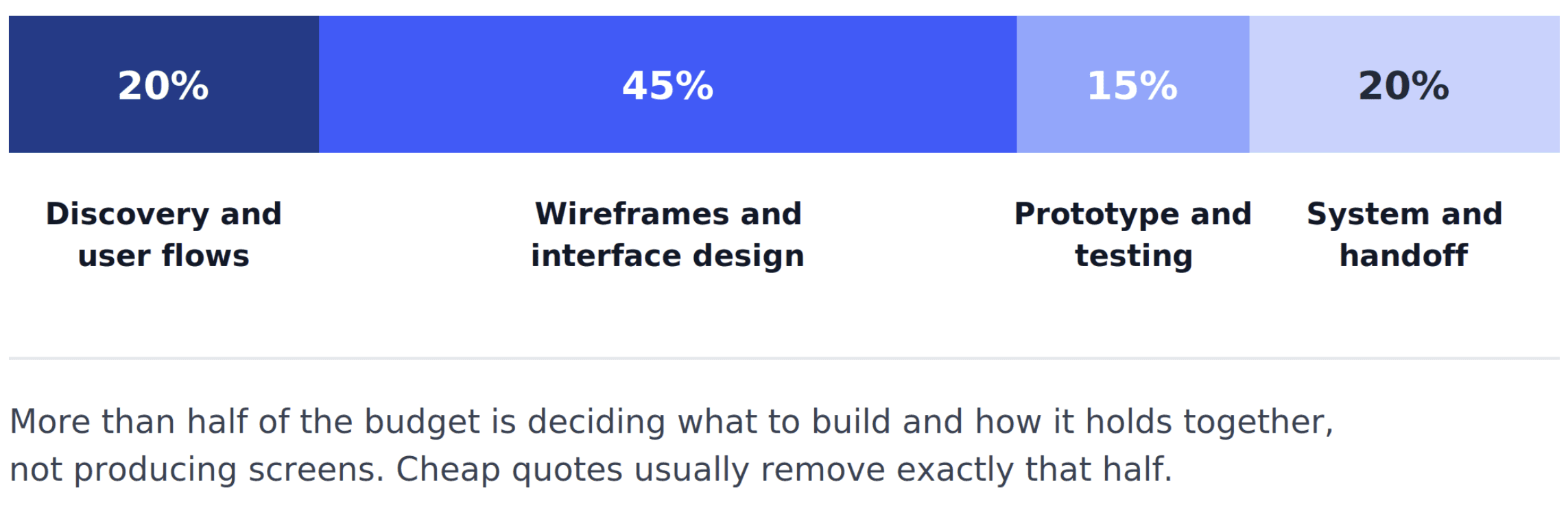
A complete MVP design engagement covers 6 things: discovery and scope definition, user flows and product structure, wireframes, the interface layer with a small design system, a clickable prototype, and developer handoff. When I break down a typical $10,000 project, roughly 20 percent goes to discovery and flows, 45 percent to wireframes and interface, 15 percent to prototyping and testing, and 20 percent to system foundations and handoff.
Notice what that means. More than half of the budget is not screen production. It is deciding what to build, in what order, and how the system will hold together when you add feature number 12. Cheap quotes usually delete exactly that half, which is why they feel like a bargain in month 1 and expensive in month 4.
Ask any potential partner to split their number into these phases. If they cannot, the scope is not defined enough to be quoted.
What drives MVP design cost up or down?
Screen count is the variable everyone talks about, but in my experience it is not the strongest one. These are, roughly in order of impact.
Number of user roles. An admin, a customer and a reviewer are 3 products sharing a codebase. Each role brings its own navigation, permissions and empty states. Going from 1 role to 3 adds more work than adding 10 screens.
States, not screens. A screen is not one artboard. It is empty, loading, error, partial data, no permission, and success. A designer who delivers only the happy path leaves this work for your engineers, who will invent it under deadline. When I estimate, I count states, and a realistic MVP has 3 to 4 times more states than screens.
Data complexity. Anything with tables, filters, bulk actions or hierarchies costs more per screen than a marketing style flow. A settings page is cheap. A permissions matrix is not.
Research depth. Talking to 5 users and running 5 usability sessions typically adds $1,200 to $3,500 and 1 week. It is the highest return line in the budget, and the first one founders try to remove.
Platform. Web first is the cheapest path to a testable product. Native iOS and Android together add 30 to 50 percent to the interface layer.
How ready you are. This one is invisible in every quote and dominates the real cost. Teams who arrive with a clear problem, a decided audience and 1 person who can approve work move about twice as fast as teams with 2 founders who still disagree about who the product is for. Better to find that out in week 1 than after the interface is built.
Pricing models: hourly, fixed price, sprint or subscription
The model matters as much as the rate, because it decides who carries the risk when scope moves. And in an early stage product, scope always moves.
Hourly. Flexible and honest, risky for you if the scope is vague. It works well for ongoing support and for teams who want to steer week by week. Expect $80 to $130 per hour with a boutique studio in Europe or the GCC, and $70 to $110 with a senior independent designer.
Fixed price. Predictable and usually includes 2 or 3 revision rounds. It works when the scope is genuinely defined. The trap is that anything outside the written scope becomes a change request, so the definition document matters more than the price.
Design sprint. A 1 to 2 week engagement, $4,000 to $10,000, to validate the core concept before you commit to the full MVP. I recommend this when the product idea is still an argument inside the team. Spending $6,000 to avoid building the wrong $25,000 product is good arithmetic.
Monthly subscription or retainer. $3,000 to $9,000 per month for continuous design capacity. This fits teams that ship every week and cannot predict what they need 6 weeks ahead. It is also the model that most resembles having an in house designer, without the hiring timeline.
For a first version, I usually suggest a fixed scope for the MVP itself, then a small monthly plan during development, because that is when the awkward questions appear and a design partner who disappeared at handoff is expensive in a different way.
How long does it take to design an MVP?
Budget and timeline are the same conversation. These are realistic durations for a focused team.

At Studio Scale we design most MVPs in 3 to 6 weeks and share the first screens within 5 business days of kickoff. That speed is not heroic effort. It comes from scope discipline and from a review rhythm agreed in advance: 2 review points per week, 1 decision maker, 48 hours to respond. Projects do not slip because designers are slow. They slip because a screen waits 9 days for feedback.
Did AI make product design cheaper?
Partly, and not where people expect.
AI tools compress production. Generating variations, writing interface copy drafts, producing placeholder content, converting a layout into a first coded version, all of that is genuinely faster than it was 2 years ago. In my own work I would estimate 20 to 30 percent less time on the mechanical parts.
What did not get cheaper is judgement. Deciding what the product should do, which flow removes the drop off, what to cut from version 1, how a system stays coherent after 6 months, that work is unchanged. I wrote about this in more detail after I let AI design my app and then did it properly.
The practical effect on your budget is this. AI lowered the cost of screens, so studios that only sold screens got cheaper. The value moved to the decisions around them, and that part of the quote is the part worth paying for. If a partner tells you their price dropped 60 percent because of AI, ask which 60 percent of the thinking they removed.
Where MVP design budgets actually leak
The number on the proposal is rarely the number you spend. In the projects I have seen go over budget, the cause is almost never the design rate.
The most common leak is rework caused by late feedback, when a stakeholder who was not in the reviews appears in week 5 and changes the model of the product. The second is scope arriving quietly, 1 small request at a time, until version 1 has become version 3. The third is a handoff that ends the moment files are delivered, which pushes 20 to 40 hours of interpretation onto engineers who bill more than designers do.
The fourth is the expensive one. Building the wrong thing beautifully. Design cost is a small share of what it costs to build and maintain a product, so a $15,000 design engagement that removes 4 unnecessary features from the build has paid for itself before development starts. That is the actual argument for spending money on design early, not craft or polish.
How to reduce the cost without breaking the product
Cut scope, not stages. A smaller product designed properly beats a bigger product designed halfway, and it is also faster to build.
Concretely: pick 1 platform for version 1, start with 1 user role and design the second one after you have real users, choose 3 to 5 core use cases and defer the rest to a written later list, use an existing component library as a base instead of drawing a design system from zero, and skip custom illustration until you know the product works. Bring your engineers into the flow reviews, not only into handoff, because the cheapest simplification usually comes from a developer saying that 1 approach takes 2 days and the other takes 3 weeks.
What I would not remove: talking to real users, the states, and handoff support. Those 3 lines are small in the budget and enormous in the build.
What to ask before you sign
Ask what happens when scope changes, and listen for a process rather than a promise.
Ask how many revision rounds are included and what counts as a round.
Ask to see the deliverables from a past MVP, specifically the states and the handoff documentation, not the portfolio shots.
Ask who does the work, because in some agencies the person in the intro call is not the person in your file.
Ask what they will cut if the timeline gets tight.
And ask what they need from you every week, because a partner who has no answer has not planned a rhythm.
If you want a longer version of this checklist, I wrote a separate guide on how to choose the best UX/UI design studio for your startup.
FAQ
How much does it cost to design an MVP? In Europe and the GCC, between $5,000 and $12,000 with a mid level freelancer, and $12,000 to $30,000 with a boutique product design studio for a web MVP of 15 to 25 screens. Mobile, multiple user roles and data heavy interfaces push it higher. The same scope in the US usually costs 40 to 60 percent more.
How much should a startup spend on design? As a rough planning number, MVP design tends to be 10 to 20 percent of the first build budget. Below that, engineers make product decisions in tickets. Far above that, you are polishing before you have evidence.
Can I design an MVP with AI tools instead? You can get to a plausible looking first version, and for a demo that may be enough. What AI tools do not give you is the decision about what to build, the edge cases, and a system that survives the next 3 features. Most teams I meet who started that way come back to fix structure, not visuals.
Do I need a design system for an MVP? You need foundations, not a full system. Tokens for colour and spacing, a set of core components with their states, and consistent patterns. That is 3 to 5 days of work and it saves weeks later.
Working with us
We design first versions for early stage teams, usually in 3 to 6 weeks, with the first screens in your hands in 5 business days. We work in fixed scopes for MVPs and in monthly plans during development, and we tell you when the work you asked for is smaller than the engagement you were expecting.
If you have an idea and a budget question, that is exactly what an intro call is for. Book a free 15 minute intro call and we will give you a scope and a realistic number, even if you take it somewhere else.
