
Ayşe Doğan
Jun 4, 2026
9 min read
I don’t want more apps. I want results.
How AI is changing the relationship between people and software.
I’ve noticed something over the past few months: I’ve almost completely stopped downloading new apps.
Last month, I was traveling in a city I didn’t know well. It was lunchtime, I was hungry, and I had no idea what was around me. I picked up my phone, but instead of opening Google Maps, I opened ChatGPT. “I’m here right now, looking for restaurants in this neighborhood that aren’t too crowded, somewhere I can try something different, mid-range prices.” Within minutes, I had a list in front of me. I didn’t search the map one by one, didn’t compare reviews, didn’t mess with filters. Ratings, distance from where I was standing, everything was right there.
Something clicked in my head at that moment.
I no longer look for a diet app when I want to eat healthier. I don’t go to language platforms when I want to practice English. I don’t get lost in endless articles when I want to learn something. I don’t browse restaurants on maps one by one when I’m traveling. I just describe the problem to ChatGPT or Gemini, and most of the time, I get exactly what I need.
As a designer, this started to genuinely unsettle me. Because for years, we’ve been designing for users to navigate apps faster, search more easily, use better filters, find the right feature more quickly.
We always wanted the same thing
There’s a concept that gets talked about a lot in product design: Jobs to Be Done. Users don’t actually want to use an app, they want to get something done. They don’t want to open Netflix, they want to watch a movie. They don’t want to log into Cambly, they want to practice speaking English. They don’t want to fill in MyFitnessPal, they want to eat healthier.
For years, we built separate apps to solve each of these jobs. Each with its own onboarding, its own UI language, its own notification logic. Every time, users had to learn a brand new system.
Now AI comes along and says: “Just tell me what you want. I’ll handle the rest.”
From interface to intent
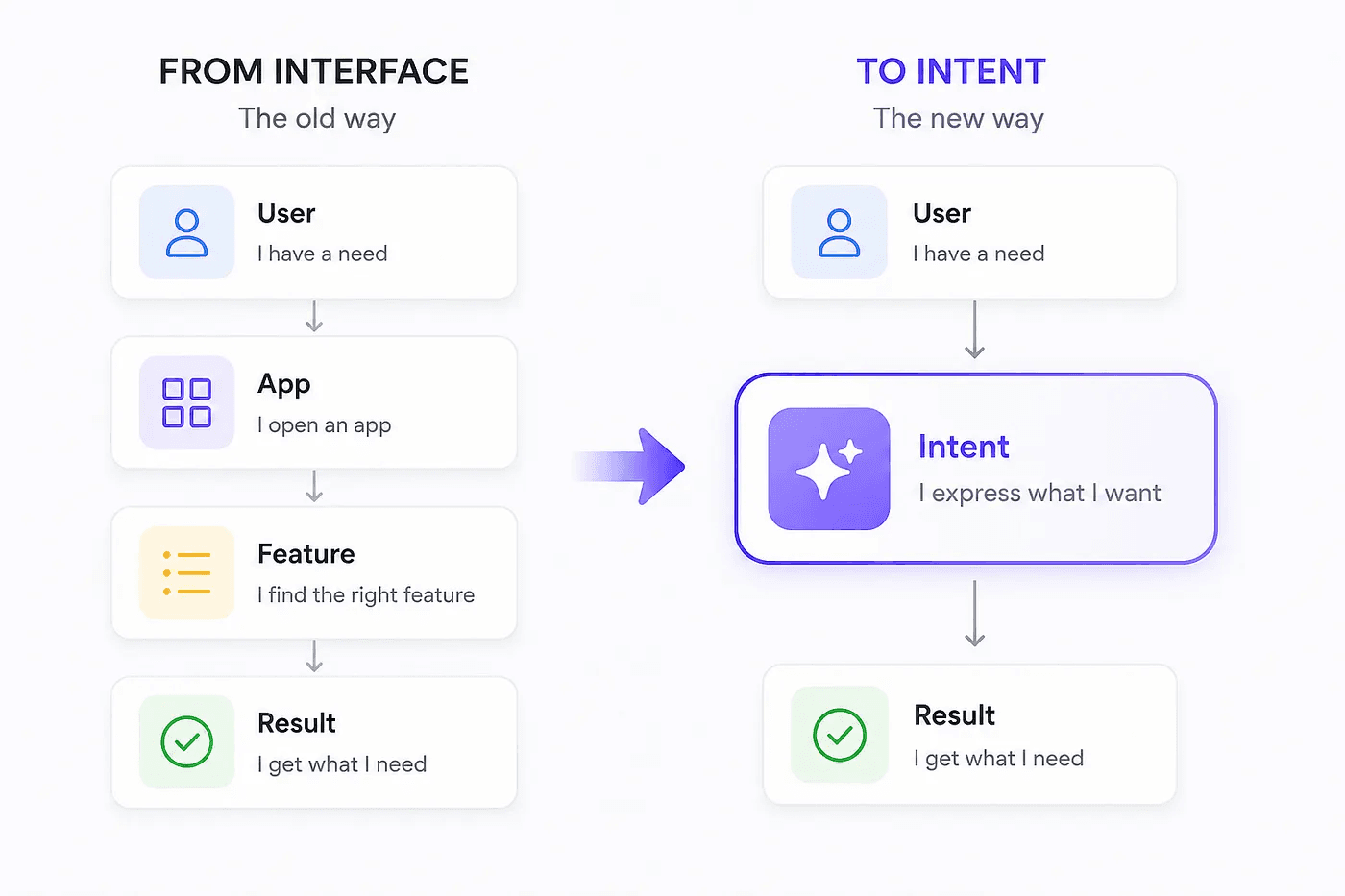
For years, digital products were built on the same logic. If we wanted to reach an outcome, we first had to find the right app, then navigate the interface it offered, and only then arrive at what we actually wanted.
User → App → Feature → Result
What we were really after was the result. But to get there, we had to follow the path the app laid out for us.
With AI, this model is changing for the first time.
User → Intent → Result
Today, more and more people are communicating not through the features an app offers, but through what they actually want to accomplish.
“I have four days in Rome next month. Put together a travel plan for me.”
“Summarize the most important things I need to know about this topic.”
They’re not selecting filters, they’re not choosing categories, they’re not trying to figure out how the app works. They’re just saying what they want.
Maybe AI’s biggest achievement isn’t giving better answers. It’s making the layers in between invisible.
Some real examples I’ve come across
Design tools: I feel this one personally. When I need a visual, I’m no longer drowning in stock photos on Freepik. Writing a simple animation in Replit has far less friction than opening After Effects. I don’t spend hours trying to visualize an idea in product design anymore, AI tools do that now. Creative energy goes toward thinking, not learning the tool.
Language learning: Platforms like Cambly offered real value for years, connecting you with actual teachers for conversation practice. Now with ChatGPT Advanced Voice, you can practice speaking English anytime. It corrects your pronunciation, flags grammar mistakes on the spot, and is available at 3am if you can’t sleep. The emotional connection of a human teacher is undeniable. But AI has made the act of “just practicing” far more accessible.
Diet and nutrition: Apps like MyFitnessPal were built for calorie counting and macro tracking. Now you can take a photo and let AI estimate the nutritional value. A request like “what should I eat this week, I might have a lactose issue, I’d rather not eat too much meat, and it needs to be quick to prepare” was never something any diet app could handle this naturally.
Online shopping: When I want to buy something, I no longer tab through comparison sites. Which option actually fits my needs, whether the price difference really matters, where I can get it, I work all of that out in a single conversation. Comparison sites still exist, but the need to visit them is quietly fading.
A system that knows you: ChatGPT remembers things I mentioned months ago and brings them up in a completely different conversation. It knows my age, my preferences, sometimes details I’ve forgotten myself. That means I don’t have to re-explain my context every single time. No app could do this as naturally, because each one only ever saw its own category of my life, never the whole picture.
Screenless interaction: You can now get an answer without even picking up your phone. Just say “Hey Gemini” and ask what’s on your mind. No app, no screen, no input field. Just voice and response. This challenges one of the most fundamental assumptions in user experience: does an interface even need to exist?

There’s one thing all of these have in common: AI is removing the layer in between.
“This is going to be very hard for an entire generation of brands”
Meta’s CTO Andrew Bosworth said in a recent podcast that AI could replace apps entirely in the way people use technology. Instead of opening Spotify to listen to music, he said he’d rather just tell an AI what he wants and let it handle the rest. “I don’t want to be responsible for figuring out which app to open to do a thing,” he added. “Brands want me to form a connection with them. I don’t want to form a connection.” He also noted that this shift “abstracts away the brand name of a lot of companies” and that it’s “going to be very hard for an entire generation of brands.”
OpenAI’s internal strategy documents reportedly describe the ambition to make ChatGPT the interface of the internet. One entry point, everything flows from there.
Even Duolingo is feeling the pressure. The company’s CPO Cem Kansu says AI has dramatically accelerated their content production. But the real question is: does the app itself still need to exist, or can AI just teach you a language directly?
Are apps really dying?
I don’t think the answer is a simple yes or no. More accurately: some apps are dying, some are evolving, and some are continuing to grow in areas AI hasn’t touched at all.
Apps that are most at risk:
Single-purpose tools: An app that only counts calories and does nothing else. A tool that only corrects grammar. AI can now handle these at a “good enough” level.
Onboarding that feels like a chore: The user fills out a 5-screen registration form, then spends 20 minutes figuring out what to do next. AI just starts a conversation and learns what you need.
Super apps: The most extreme version of this story actually goes back much further. Platforms like WeChat and Grab have been bundling messaging, payments, shopping, and transportation into a single app for years. They tested the “everything in one place” promise long before AI came along. Now AI is taking that model one step further, without an interface at all.
But some apps are in a safe place:
Those offering real human connection: The moment a teacher on an education platform asks “How are you doing today?” and makes you laugh, AI can’t fully replicate that yet.
Those that create deep habit loops: Duolingo’s streak system, badges, social competition. These aren’t just teaching a language, they’re designing behavior.
Data-driven personalization: AI’s memory feature now remembers your gluten sensitivity, sleep patterns, and dietary preferences from months ago. But converting that into quantitative data, visualizing long-term progress, tracking things in depth, that’s still where niche apps stand out.
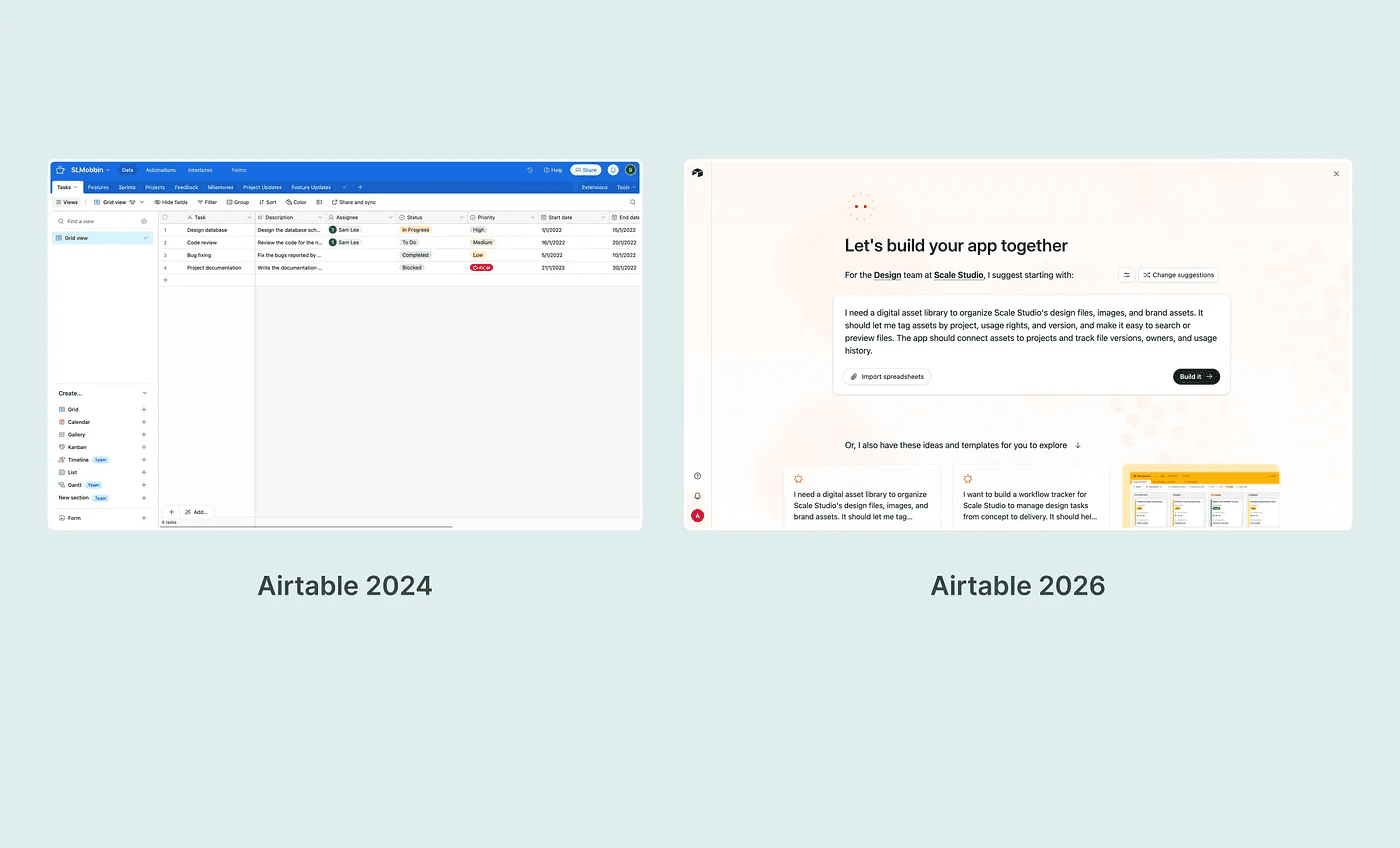
Evolving tools: The core experience of many products we use today has started to shift. Notion doesn’t ask you for a document, it asks for an idea. Airtable doesn’t ask for a database, it asks for a need. Framer doesn’t ask for a design, it asks for a website concept. Cursor doesn’t ask for code, it asks what you want to build. Products are no longer waiting for users to learn their interface. They’re trying to understand what users actually intend to do. Maybe the most important design trend of recent years isn’t a new button or a new navigation pattern. Maybe it’s the interface itself starting to step back.
Press enter or click to view image in full size
Prompts might be a temporary interface
One of the concepts that came with AI is prompt engineering. But there’s an interesting question: What if we no longer need to write better prompts?
Today, we explain who we are, what we like, and what our goals are. But as AI systems gain more context, that need starts to fade. In the future, a simple question like: “What should I eat tonight?” might be enough. Because the system already knows our goals, habits, location, and previous preferences.
Today we’re talking about prompt engineering. Tomorrow we may be talking about context engineering. And that shift won’t just change AI. It will change how digital products are designed.
What does this mean for design?
This is the part I’ve been thinking about the most. If people gradually open fewer apps and spend more time telling AI what they want, what exactly are we designing as designers?
1. Prompt design becomes the new UX: Teaching users what to say and guiding them toward better outcomes is becoming a discipline of its own. Nielsen Norman Group has already started treating prompt suggestion design as a separate area of expertise.
2. Apps move behind the AI layer: Many SaaS products are shifting away from being destinations and becoming infrastructure. The AI interface talks to the user, while tools like n8n, Notion, and Spotify operate in the background.
3. The input field becomes less important: In a world where you can simply speak to Gemini and get an answer without even picking up your phone, the input field, one of the most fundamental elements of interface design, can sometimes become unnecessary. We spent years designing placeholder text, error messages, and form validation. But what happens when users stop typing altogether?
4. Experience design becomes even more valuable: If competition between tools starts to fade, brand perception, trust, and emotional connection become more important. The feeling of “this AI understands me” may become a new measure of UX quality.
As designers, we’re entering a period that feels both exciting and slightly uncomfortable. For years, we focused on questions like: “What will users click?”, “Where should this feature live?”, “How can we make this flow easier to navigate?” Then we shifted toward a different question: “How can users express what they want?” Soon, we may find ourselves asking something even bigger: “What do users want before they have to think about it?”
Because if people can get answers without opening an app, touching a screen, or even typing a prompt, then perhaps the thing we’re designing is no longer the interface. It’s intent. I don’t think apps are dying. But I do think they’re being reinvented.
And if designers want to remain part of that future, we may need to stop seeing AI as a competitor and start seeing it as a design material in its own right.
